

The Golden Rule of AI Content
Navigating the generative AI era through management of polarities

I recently saw a post on LinkedIn where the author shared that she felt more pressure to use AI as an adult than to do drugs in high school or college. The post had thousands of reactions in less than a week.
Honestly, that sentiment resonated with me.
Especially since launching my business, I’ve been inundated with questions about how and where I’m integrating generative AI into all sorts of areas. Early adopters are sharing their success of inputting mass amounts of data to recreate their human writing voice through AI and create more output than ever before. At the same time, I’m seeing more and more critical commentary about AI-generated content on LinkedIn, Substack, and other forms of traditional and social media. Readers and writers alike are sharing fatigue with tropes now associated with AI – including the poor em dash who went from unsung hero of punctuation to persona non grata seemingly overnight.
The message I’m hearing is 1) Leverage AI as much as you can, as fast as you can, to make as many things as you can better than ever; but also 2) Your human voice, analysis and tone is valuable and should not be substituted by AI outputs for writing to be meaningful and appreciated by readers.

Which one do I pick?
It’s a great question – and one I continue to come back to.
A polarity, or paradox, is “a situation in which opposing forces within a system pull at each other to keep things balanced” (Harvard Business Impact). Examples of polarities include inhaling/exhaling, work/life balance, and liberal/conservative. Ultimately, both poles must be present and the tension will always be there – even when it feels uncomfortable. The Polarity Map, originally created by Barry Johnson, has been used for 50+ years as a way to help leaders navigate interdependent, conflicting pairs that bring natural tension while generating balance.
Recent advances in genAI have resulted in a new polarity for writing:
AI-generated content and authentic human voice & analysis.
In today’s technology setting, both are viable pathways and increasingly in conflict, particularly as genAI gets more and more embedded into digital tools and reader fatigue on AI-generated content grows. A polarity-mapping exercise considers the benefits and drawbacks of each polarity.
AI-generated content offers efficiency, scale, and consistency with clear benefits such as speed from inception to creation, ease of streamlining formatting and writing style across posts, and decreased cognitive load for the writer. However, that same speed and efficiency can lead to generic-feeling outputs, risks of missing key details or overlooking fallacies within the content, and inclusion of “AI flags” indicating the content doesn't have a distinctly human origin. Concurrently, a focus on human voice and analysis takes longer to develop, inconsistencies (intentional or unintentional) emerge across articles, and content is hard to scale without additional resources. However, the human-first content offers nuanced stories, unique to the author, that leverage our human experience while also building trust and credibility with the audience.
Managing Polarities
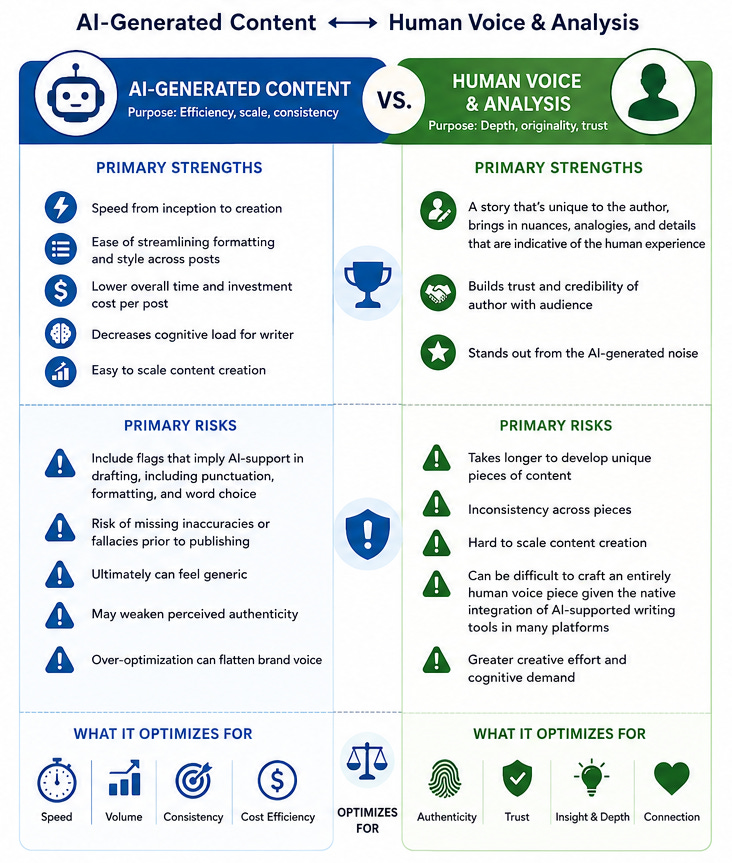
The polarity map surfaces the tradeoffs to consider and highlights friction points. A 2x2 scenario planning exercise asks what happens when these forces play out at scale and offers another lens to consider what these intersections yield.
Scenario Planning with Polarities
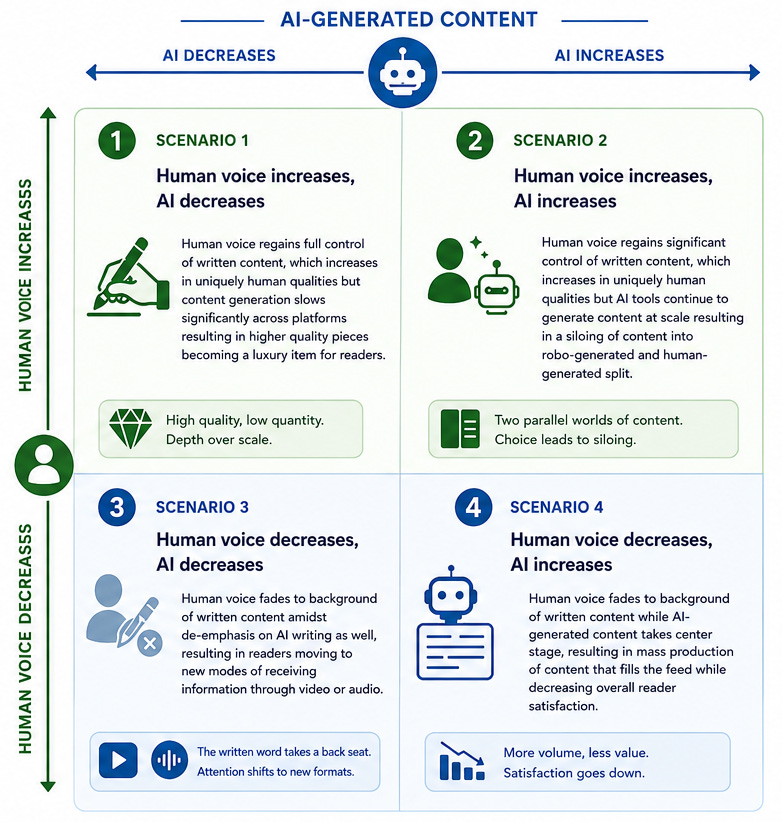
In a world where AI-content tools have reached the point of mass-proliferation, we can’t really envision Scenarios 1 or 3 truly coming to pass. Our human voice is unlikely to truly be “eliminated” but could fade to the background. With this in mind, my actionable insights for navigating this paradox focus on opportunities for the human voice in consideration of Scenarios 2 and 4:
Use the amount of AI optimization that you, as a reader, would want to experience when you’re reading others’ content. I think about this as the manifestation of the golden rule for navigating AI content use: produce AI content for others as you would have them produce AI content for you. This is a rule of thumb for estimating how much is too much…and where AI can supplement your work without taking away from the original human intention and voice. For me, article titles are a space where I tend to get stuck and I’ll lean on AI recommendations for coming up with something descriptive yet pithy. Using AI to create a quick illustration (see above!) using my written content also helps me bring a concept to life faster.
Leverage AI as a fact-checker, proofreader, assumption review mechanism, or key takeaway analysis – but keep the origin of the piece within your human tone. One of the most useful applications I’ve found for genAI is to share an article draft and ask for an analysis of key takeaways without disclosing my intended thesis as part of the prompt. This helps me mimic the fresh-perspective experience of having someone review an article without actually asking them to take on the cognitive load.
Evaluate the why behind AI-usage. If the story isn’t worth the time to begin a draft, perhaps it’s not a story that needs telling today. If I don’t have enough inspiration to start the narrative and get to a strong first draft before needing technology assistance, this tells me that the idea isn’t yet mature enough to build out into an article. If I find myself deprioritizing writing time within my week and needing technology to fill that gap, that tells me that my own capacity-planning is off – and that is a key metric to consider for my planning and prioritization within the business.
Today, these are the next steps that make the most sense to me as I think about my role as a writer during the genAI era and consider how to best utilize emerging technologies without losing my original human intentions within Strategy Stories.
Are you experiencing this polarity? How are you navigating this tension?
Thanks for reading Strategy Stories by Lavorgna Strategy Studio!
About Strategy Stories
Strategy Stories is the insights vertical of Lavorgna Strategy Studio, a consultancy helping leaders, teams, and organizations prepare and plan for the future through strategic planning and strategic foresight.
Curious how these frameworks translate into practical strategy for your organization? Connect with Jackie Lavorgna, Founder and Principal, to learn more.