

Signals at the Edge: Cryopreservation for Endangered Species
When the future of biotech goes cryo

Signals at the Edge is a new recurring Strategy Stories series that spotlights emerging signals shaping tomorrow and unpacks strategic implications and insights for your strategy today.
Signal
Colossal Biosciences recently announced a new initiative in partnership with Dubai’s Museum of the Future to create a cryopreservation biovault of genetic material from endangered species worldwide.
You may have previously heard of Colossal Bioscience’s dire wolf DNA analysis and gene-editing work. The biovault, Colossal Biovault and World Preservation Lab, will be established inside of the Museum of the Future and will host millions of frozen tissue and biological samples. The UAE government is a significant funder for the project.

This signal demonstrates a move towards strategic optionality at a biological level that goes beyond traditional conservation efforts amidst heightened environmental risks. By preserving genetic materials, scientists will be able to access genetic diversity for long-term conservation research as well as utilize viable material to support future recovery efforts if populations are lost in the future. As a public-facing laboratory, visitors to the museum will be able to see the biovault and experience the future of conservation in action. The intention is for this to be the first of a future global network of similar sites.
Why This Matters
This signal challenges the long-term assumption that the main levers for conservation management are habitat preservation, species management, and public education. This is a pivot from stewardship and preservation to optionality, recoverability, and engineered resilience. By transcending the conversation from conventional conservation levers, the biovault positions cryopreservation as an emergent strategy in the conservation management field.
With financing from the UAE government and housing of the biovault in a public-facing setting, this signal demonstrates collaboration between public and private entities and a commitment to engaging the public eye in highlighting this initiative. This differentiates the endeavor from closed-off similar seed biovaults, such as Svalbard Global Seed Vault, which store millions of samples of crop varieties to preserve agricultural diversity.
The scale of financing and planning demonstrates preparation for an uncertain future where the presence of today’s species is not taken for granted.
Possible Futures
Assuming the success of the biovault initiative in curating and housing samples, sufficient biotech progress to fully utilize the material at scale, and the continued exacerbation of extinction risks, four possible futures arise.
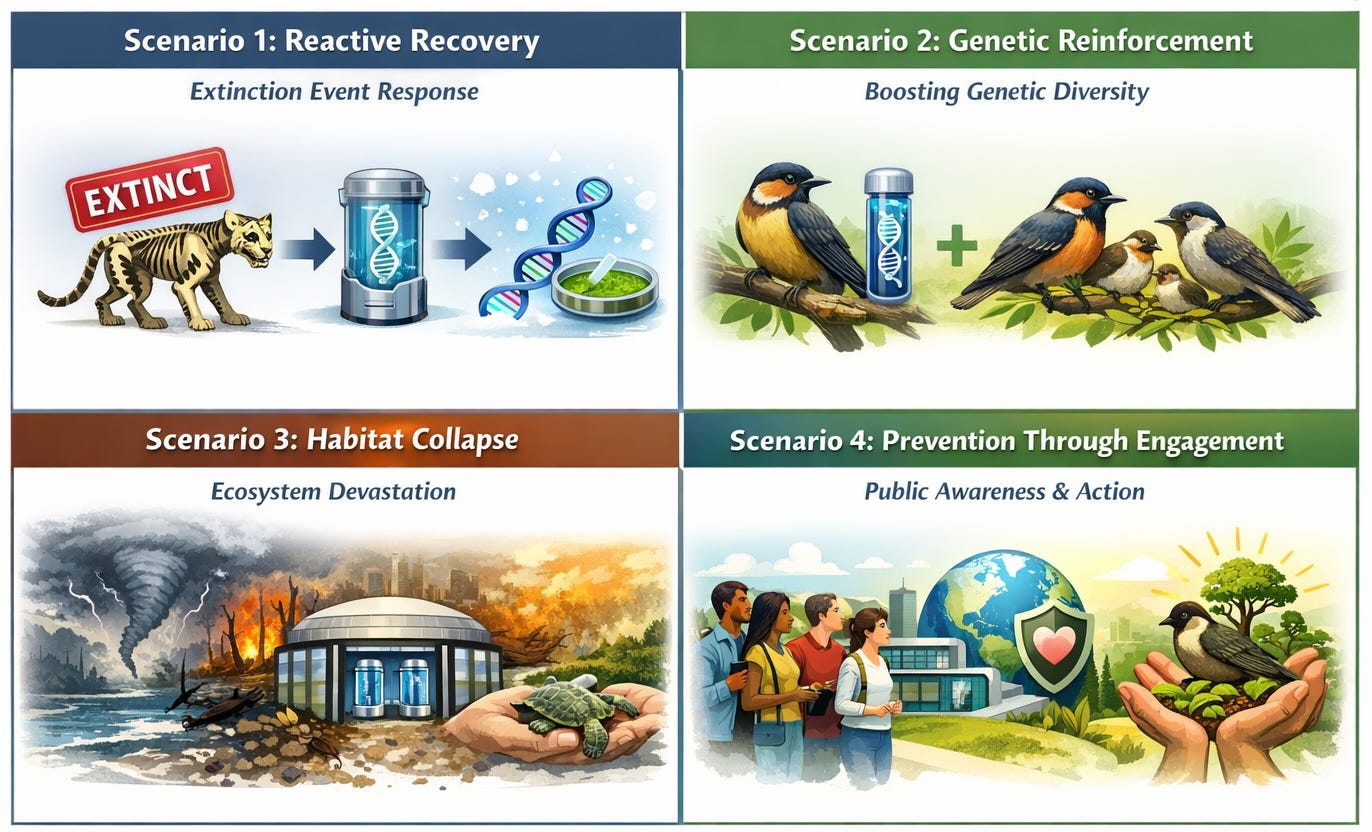
Scenario 1: Reactive Recovery
An endangered species unexpectedly goes extinct. Genetic material in the biovault offers an expedited starting point for recovery efforts.
Scenario 2: Genetic Reinforcement
A conservation management strategy for an endangered species is on the brink of success, but struggling from a lack of genetic diversity. The biovault houses critical supplemental material to save the species.
Scenario 3: Habitat Collapse
Total habitat collapse for many endangered species is caused by unpredictable climate change weather events. When ready for the re-introduction of species, the extensive collection in the biovault is the keystone for future biodiversity recovery efforts.
Scenario 4: Prevention Through Engagement
Public awareness of the risks for endangered species and engagement with the biovault’s external-facing offerings reaches such a high level that protections for endangered species are adopted with ease. The biovault continues to exist as a strategic meeting point of conservation, biotechnology, and public interest.
Cross-Industry Insights
As a signal, the biovault is at the intersection of biotechnology, conservation, public engagements, and geopolitics. However, insights from this signal highlight four strategic shifts that apply across industries:
From protecting what exists to preparing for what could fail by leveraging scenario planning to identify probability and preparation needs for low-probability, high-impact events
From assuming continuity to stockpiling for volatility by making deliberate investments and building data backups prior to a crisis event
From mitigating risk to building contingency plans through infrastructure planning
From public relations campaigns to bridging strategic investments with public awareness and engagement opportunities
The biovault initiative demonstrates a commitment to imagining the unthinkable and designing for recovery.
A Closing Anecdote
My first exposure to the concept of cryonics came from Eoin Colfer’s children’s novel, Artemis Fowl: The Eternity Code. In the novel, Artemis solicits assistance from a cryonics health facility to preserve the life of his caretaker following a presumed fatal injury. As a young reader, I had a lot of questions about the viability of cryonics as a life-saving strategy. While his approach wasn’t scientifically viable at the time…or now…this signal may take us one step closer to the possibility of leveraging the broader study and application of cryonics to yield transformational, future-shifting results.
Cryonics evolved from a speculative fiction plot point to a strategic government investment in just two decades.
What’s possible in the next decade to come?
About Strategy Stories
Strategy Stories is the insights vertical of Lavorgna Strategy Studio, a consultancy helping leaders, teams, and organizations prepare and plan for the future through strategic planning and strategic foresight.
Curious how these frameworks translate into practical strategy for your organization? Connect with Jackie Lavorgna, Founder and Principal, to learn more.