

Rolling Through the Noise
A foresight exercise in conflicting signals — and what the tension reveals

My typical travel companion is a versatile backpack, a duffel bag, or a duffel bag backpack. You’ll rarely see me with a roller bag in hand at the airport.
Why’s that?
Two main reasons: 1) I’m here to avoid checked baggage fees whenever possible; and 2) Roller bags are vulnerable - you’re relying on the wheels, zipper, and handles to function perfectly, otherwise it’s impossible to carry with ease.
As it turns out, my roller bag barrier points are not unique, and luggage trends and signals today yield an interesting foresight question for considering the future of travel.
Trend: Increasing Baggage Fees Across Airlines
Climbing fuel costs resulting from the ongoing conflict in the Middle East prompted United Airlines, JetBlue, Delta Airlines, and Southwest Airlines to raise checked baggage fees over the last month. With most major airlines increasing fees, this demonstrates a new trend in higher checked bag fees which will be felt by many consumers preparing for summer travel. By increasing the cost of checked bags, customers may not be discouraged by initial price estimates and will have already committed to their travel plans before seeing the checked bag fee at the end of the booking process. Price increases range from $4 to $10 per bag so far – a modest increase – but a dramatic increase for Southwest customers who were accustomed to free checked bags up until last year. While this move may not stop customers from traveling, the increased cost may be enough to make customers question whether they really need to bring that roller bag.
Signal 1: Abandoning Your Roller Bag at the Airport
Travelers in Japan have already been questioning whether the roller bag is needed. Luggage abandonment has become more frequent in Japan as travelers seek to avoid checked bag fees and overweight bag penalties. While this is not yet a widespread, quantitative trend, there are a number of anecdotal stories of travelers abandoning luggage. Sometimes this is directly to avoid fees, and the choice to discard personal or perishable items is weighed by the traveler in the moment. Other times, a faulty or worn out bag becomes easier to discard. The tradeoff is considered: bring the roller bag and the packed items home, or cut the loss and carry home fewer material possessions and avoid the baggage fee. Hotels and airports are left with the challenge of navigating the waste from discarded bags, choosing to auction, give away, or repurpose the bags to avoid depositing them at the landfill.

Signal 2: Reimagining the Roller Bag
With the rising fees and stories of abandoned roller bags in mind, you may be ready to join me in the backpack club.
However, Cotopaxi recently announced a new product that runs counter and provides an alternate look at the future of travel luggage.
Known for adventurous and versatile backpacks, Cotopaxi launched a new roller bag line, Coraza, in late April which takes on the weak points for roller bags: 1) Risk of zippers breaking and leaving the bag wide open; and 2) Risk of wheels or handles breaking and leaving the bag immovable without serious arm strength. Recognizing the challenge of fixing a broken zipper on the go, the Coraza bag instead closes with reinforced latches that snap shut and avoids the zipper risk altogether.
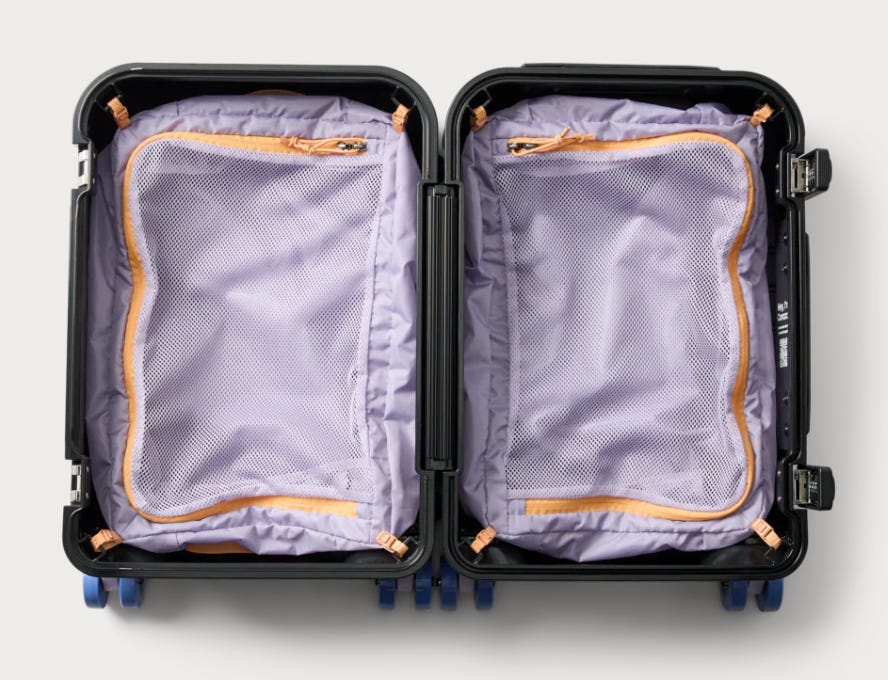
Outside of the design innovation, the Coraza bag comes with a lifetime warranty – which isn’t rare in the luggage industry – but this warranty is designed around sustainability and lowering the amount of bags that end up in landfills. Most luggage companies require you to mail the bag back, or will simply send you a brand new bag while you discard the broken item. However, replacement parts for the Coraza bag’s latches as well as for the swappable and customizable wheels and handle can be shipped directly to the traveler, with installation instructions, keeping the original bag on the road and in use for a longer time. While the bag is designed to be enduring, the starting price at $295 USD anchors the model at the higher end of the rolling luggage industry and risks positioning sustainable goods as a premium, rather than widely accessible, option.
The Conflict
The rising fees trend warns us to avoid bringing a roller bag and risking a checked bag fee at all costs. The first signal suggests for us to evaluate whether we really need to bring that bag/shoes/sweatshirt/snacks home with us…and to consider abandonment. The second signal invites us to consider a long-term commitment to a roller bag with replacement options available for the most vulnerable parts of the bag. These signals are in conflict with each other, and the latter does not correlate with the industry trend.
What makes the Cotopaxi bag an interesting innovation signal is this inherent conflict. Can a sustainable roller bag, priced at the high end of the suitcase industry, find its customer amidst a landscape of higher checked bag fees and emerging habits of abandoning bags? Maybe.
More critically, the Cotopaxi signal embodies a different focus altogether. Building a more sustainable and durable bag is a better choice environmentally, and for consumers who can, and want, to opt in to this approach upholds Cotopaxi’s founding belief that business can be a force for good.
You may or may not be in the midst of planning airline travel, or in the market for a new roller bag. However, this trend and signal intersection offers versatile key takeaways regardless of your industry, or travel plans:
Monitor Social, Technology, Economic, Environmental, and Political (STEEP) trends to track and anticipate potential unexpected impacts to your strategy, such as political conflict driving an increase in checked bag fees.
Trends are observed over time and are accompanied by data points. Anecdotes, such as the abandonment of luggage at airports in Japan, are not yet trends…but they represent the initial stories that could converge into long-term, widespread data over time. Keep an eye out for interesting stories that could grow up into big, disruptive trends.
Thought-provoking innovations arise from questioning unquestionable assumptions. Roller bags close with zippers. Imagine a roller bag without zippers? Seems preposterous, until you remember that zippers are the weakest point of the bag. This is reminiscent of Sanderson’s book with black pages from last year which questioned the assumption that book pages need to be cream-colored.
Conflicting signals or trends are not a sign that you’re doing foresight or innovation research wrong. Rather, identifying areas of contradiction is the start of some of the most interesting analyses, offering an opportunity to challenge your assumptions and consider unexpected convergence points. The most useful foresight work happens in the space where signals conflict and the resolution isn’t yet clear.
Thanks for reading Strategy Stories by Lavorgna Strategy Studio!
About Strategy Stories
Strategy Stories is the insights vertical of Lavorgna Strategy Studio, a consultancy helping leaders, teams, and organizations prepare and plan for the future through strategic planning and strategic foresight.
Curious how these frameworks translate into practical strategy for your organization? Connect with Jackie Lavorgna, Founder and Principal, to learn more.