

Q2 Check-In: Fortunately, I Hadn't Trained in Perfection
What a rainy marathon taught me about resilience, pivoting, and staying focused on the long-term goal

Mid-year is when progress on resolutions, or personal goals for the year, can either be accelerated or be wholeheartedly abandoned. I choose the former.
My first post in this series invited you to rethink the process for setting New Year’s Resolutions. My second post offered a framework for your Q1 personal strategy review. For the third post, as we near the middle of the year, I wanted to take a different approach and give you a deep dive into how one of my resolutions is going.
Resolution: Run a Full Marathon
I ran my first full marathon in Manchester, NH in November 2025. I caught the marathon bug and couldn’t stop talking about signing up for my next one after that. New England winters are not marathon-friendly, however, and I chose to wait until spring to run my second marathon. One of my goals for 2026, under my health focus area, was to run a full marathon in less time than my November marathon.
Selecting the Race
I intentionally kept the marathon goal a bit broad. Recognizing that I was still new to the distance and that marathon difficulty varies greatly across courses depending on the elevation profile, I aimed for “less time” as opposed to a specific time benchmark. I also kept the “which” marathon part vague, understanding that my work and travel schedule varies and there may be some need to be flexible during the year about my commitments.
I registered for the Vermont City Marathon which is held at the end of May. With a lower elevation profile than Manchester but some steeper climbs, I knew these would be similar in difficulty and felt prepared to revisit my training plan template from last fall and jump in.

The Training: An Exercise in Disruption, Regardless of Planning
My fall 2025 marathon training plan is covered in precise lines and check boxes from left to right, up and down.
The spring 2026 plan looks just a little bit different.
I ran into challenges throughout my training including…
An extra long, snowy winter making it tough to move outside for my long runs
A broken treadmill at a hotel during a consulting trip
A lot of days with dreary rain
An early spring cold I just couldn’t run through, or shake off
A sudden bout of hip pain during the taper period, the reduced-mileage weeks immediately before a race
Each of these unexpected challenges required 1) a pause to identify the issue; 2) brainstorming of alternative approaches; and 3) executing on the pivot. Once it became clear that winter was staying a bit longer, I identified my max treadmill distance (10 miles) and then committed to driving to a route with better maintained sidewalks and walking paths than the immediate neighborhood for runs that would last longer than 10 miles.
I brought running sneakers to Alaska in the middle of winter during a consulting engagement only to discover that the treadmill in the hotel gym was broken. I resolved to cross-train on the stationary bike instead. I also had quite a few days, including a couple long runs, where I needed to get outside for a run even though it was raining. Dressing well and mentally preparing for being wet, chilly, and uncomfortable carried me through.
Running through a cold or unexpected joint pain is possible, but often not the best approach. When I encountered these health challenges during my training, I took the intentional break and let my body recalibrate before jumping back in. This was a key lesson learned from my fall training plan when I inadvertently pushed through ankle tendon pain for an entire month.
The Race: A Parallel Experience of Disruption, Prepared for By Training
Finally, it was marathon day!
My wonderful family was up early with me that morning, watching the rain fall down. We knew it was going to be a wet day. I joined the pack of runners with ponchos, windbreakers, and shoe covers on, with all knowing this would be a long morning.
Over the course of the next 26.2 miles, I encountered a lot…
Pouring rain at the start, which eased up about an hour in
Navigating a muscle spasm in my right leg for the first 8 miles
Overheating in my soaked running jacket after the rain let up
Abandoning my jacket around mile 20
Being cold and soaked (again) when the rain started (again) in the last half hour of my run
Fortunately, I hadn’t trained in perfection. I had navigated obstacles and challenges throughout my training period, and while I hadn’t specifically prepped for these, I had sharpened the mental resilience needed to keep going when literally every element said stop!
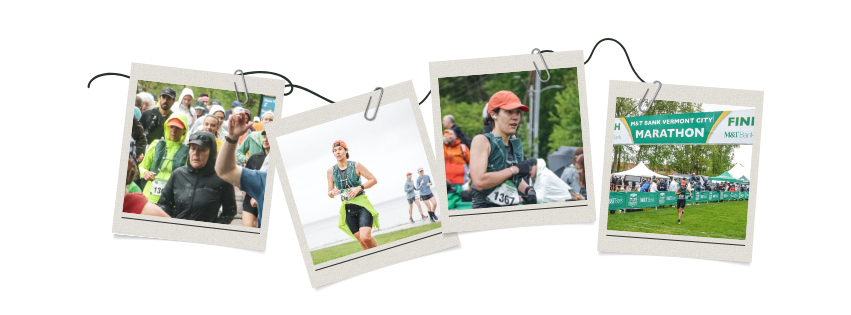
I stayed in good spirits about the rain, joking about the weather right up until start time. I eased up early on to assess the muscle spasm, confirming that it was a twitch and not a sharp pain, and carried on. I adjusted my jacket when I needed to, moving my bib to my shirt underneath when the heat became too much, and didn’t get (too) discouraged by how this disrupted my pace. Finally, I maintained a good attitude throughout the rain…especially towards the finish, because there’s nothing more motivating than knowing you’ll get to be somewhere dry soon (ideally with a heat shield blanket). In the end, I knocked off a couple minutes from my first marathon time — not as dramatic a difference as I might have liked, but tangible progress forward amidst a hard training cycle and a challenging weather day.
What made this experience easier was getting to see my family four different times throughout the course, which is a major benefit of a double figure eight loop, and experiencing the amazing energy of the Burlington community. Rain couldn’t keep the local spectators down. From front porch rock bands to families handing out shots of maple syrup in their neighborhoods, the Burlington community brought vibrant energy no matter the weather.
The Learnings
Most critically, I learned three strategic lessons to tackle for my next marathon:
The best laid plans can still fail on first contact. With an n of 1, my first marathon training plan was followed to near perfection. With an n of 2, my success rate on plan adherence is quite a bit lower. Staying focused on the long-term goal – run a marathon – instead of short-term roadblocks helps maintain momentum when everything feels astray.
A positive mindset can compete against the most undesirable elements. Think “I get to do this because I’m ready for this!” instead of “I can’t believe I have to run over 20 miles in the pouring rain.”
Last minute details may feel minor in planning, but can take on a seismic role in execution. For me, that means don’t attach a race bib to an exterior jacket ever again.
In closing, as you think about your goals for 2026, you may be encountering your own version of roadblock and obstacles that just keep disrupting your plans. Keep focused and find ways to pivot and adjust approaches where needed. When you reach the goal, no one is asking what your training plan logbook looked like leading up to the day.
Thanks for reading Strategy Stories!
Coming Soon
In June, Strategy Stories is launching a paid membership tier. Each month, paid members will receive one exclusive piece of curated content, rotating among items such as deeper analyses, downloadable tools, guest perspectives, and signal spotlights designed to go further than the free posts and move from strategic thinking to strategic action. I’ll share more details in the coming weeks.
About Strategy Stories
Strategy Stories is built on a single belief: the most useful strategic insights don’t always come from inside your industry. Through this platform, I share case studies, analyses, and anecdotes written for curious leaders, strategists, innovators, and futurists, spanning an audience across 23+ US states and 16+ countries.
Strategy Stories is the insights vertical of Lavorgna Strategy Studio, a consultancy helping leaders, teams, and organizations prepare and plan for the future through strategic planning and strategic foresight.