

Owning the Origin, AI or Human
What Spotify and NYT are signaling — and what artifacts from the future reveal about content authenticity

Two interesting signals popped up in the same week on my phone, both originating from mobile app subscriptions, both about AI attribution, and both taking completely different approaches. These two signals would have seemed inconceivable just five years ago. This is the best part of signal scanning, and I couldn’t wait to share this convergence with you.

Signal 1: Spotify’s Prompted Playlists
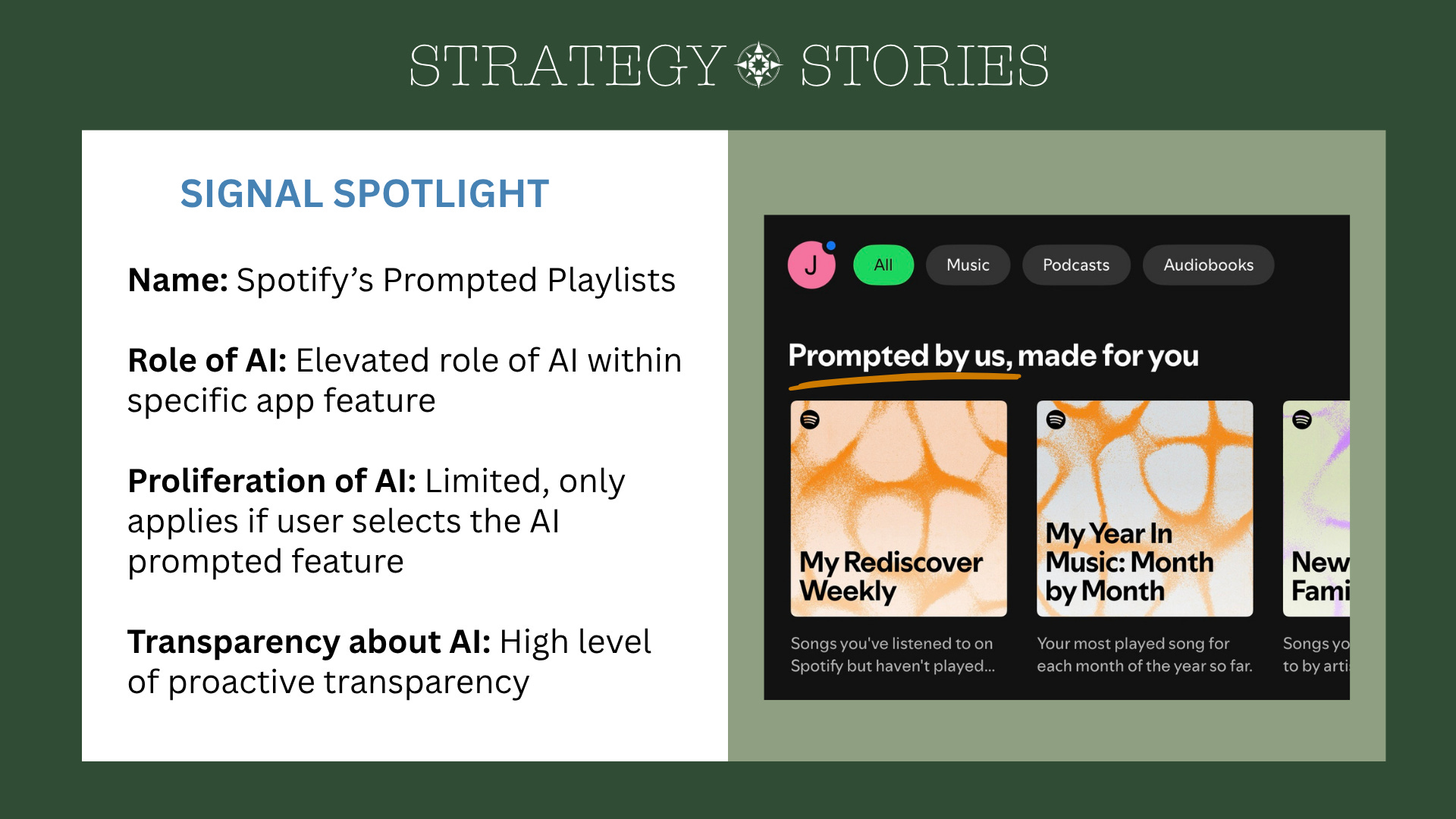
Spotify released a new feature called Prompted Playlists where listeners can choose from pre-written prompts, with customization options, or write their own new prompts to craft a fresh set of tracks. The section of the app is specifically labeled “Prompted by us, made for you” – highlighting the specific role of generative AI in creating the playlist, leveraging the listener’s Spotify data. What interested me most, other than the AI-first labeling, was how this new feature competes directly with Spotify’s existing, automated playlist generation leveraging listener data to create new playlists across a variety of categories.
Signal 2: NYT Puzzles, Made by Humans (Confirmed)
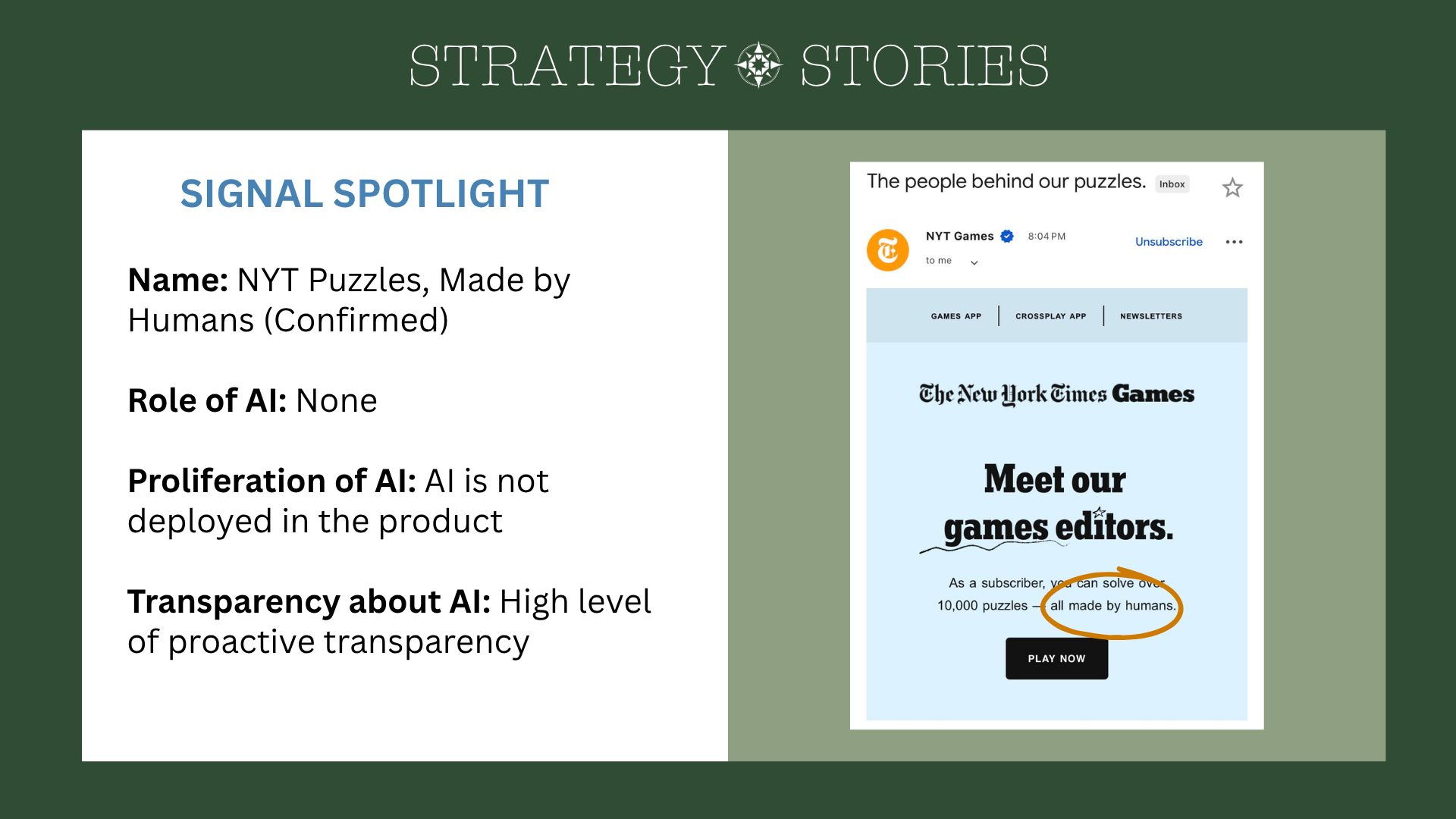
Within the same week, I received an email from the New York Times (NYT) Games app. As you may know, I love Crossplay so I was quick to open this email to read the latest on NYT Games. With the subject line “The people behind our puzzles,” the email profiled game creators employed at NYT and reminded subscribers that they have access to “over 10,000 puzzles – all made by humans.” Across games such as Wordle, Connections, and Mini Crossword, the potential for leveraging generative AI to reduce manpower needed to produce the daily games is certainly there. Concurrently, at a time when app and game creation has never been easier with vibe coding, NYT took the extra step to affirm that they are continuing to rely on humans to create, curate, and edit new puzzles. What intrigued me most about this email was that NYT proactively contacted subscribers to answer a question they may not have even been asking (“Are Connections categories selected by a human?”).
Two different signals. Two different approaches to leveraging AI. Two very bold statements about the level of AI utilized in their end product to users.
Applied Foresight Exercise: Artifacts from the Future
Building on the analysis underpinning Scenario 2, where human voice and generative AI increase in tandem, from last month’s Golden Rule of AI Content on Strategy Stories, these two signals inspired me to create a set of artifacts from the future. I first learned about the artifacts from the future exercise from Institute for the Future (IFTF) as part of the IFTF Foresight Toolkit.
When building an artifact from the future, you can transform abstract concepts of ideas about what the future may hold into tangible examples of what change could look like in the future. This creates an accessible, shareable artifact that can help others envision possible futures and clarify what kind of future you want to move toward.
What would it look like if these two signals – explicit AI content labeling and human-origin affirmation – became mainstream across a broad array of content, products, and services?
Consider a future where both the human voice and generative AI continue to proliferate in tandem, but perhaps not in harmony, and the implications of these two signals expands into the general market.
I am excited to present Origin Authenticity Badges, an artifact from the future.
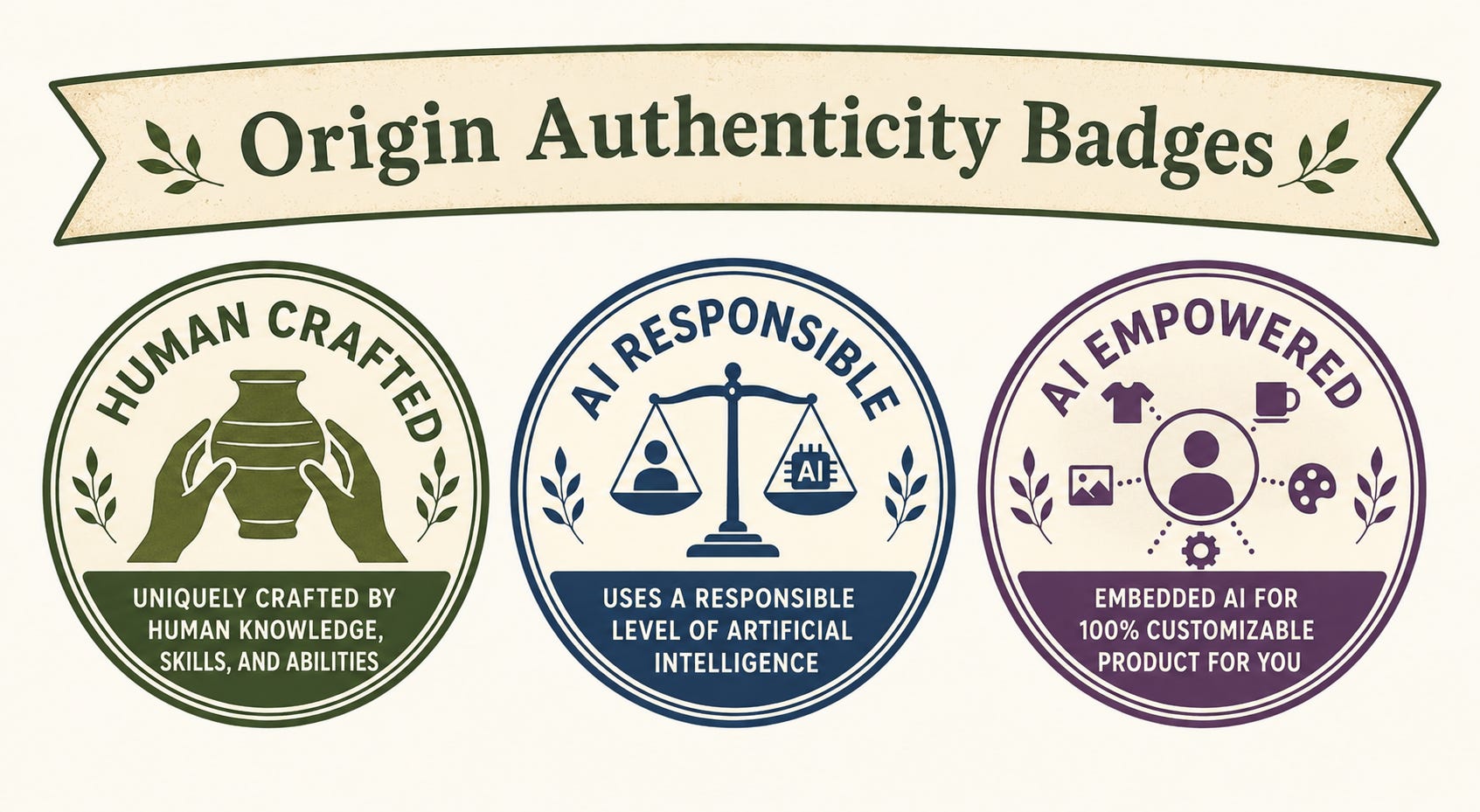
Imagine a future where these origin authenticity labels, authenticated by an independent regulation and certification body, are included with products or services you are considering purchasing, similar to certified food labels we see today.
As you envision what this would mean, consider these questions:
Would this shape your purchasing decision? If so, how?
Would you find value in this level of transparency? Why or why not?
What excites you about this possible future? What makes you nervous?
What I didn’t see in this wave of signal scanning was a good medium option, if we consider a Goldilocks approach. This would be an approach that utilized just enough generative AI to meet the user’s needs for customization, speed, etc. while being transparent about the level utilized. The notion of a measured, transparent AI approach is certainly intriguing, and still included in the artifacts from the future set to give balance. That isn’t to say they’re not out there – as futurist and author William Gibson says, “the future is already here, it’s just not evenly distributed.”
Go Further with Strategy Stories
Strategy Stories paid membership is now live. Each month, paid subscribers receive one additional piece of curated content — such as a strategic framework, downloadable tool, or resource guide — designed to help you move from strategic thinking to strategic action. First Readers rate of $56/year available through June 30. Learn More.
About Strategy Stories
Strategy Stories is built on a single belief: the most useful strategic insights don’t always come from inside your industry. Through this platform, Jackie Lavorgna, PhD, SMP shares case studies, analyses, and anecdotes for curious leaders, strategists, innovators, and futurists — spanning readers throughout the United States and across 16+ countries.
Strategy Stories is the insights vertical of Lavorgna Strategy Studio, a consultancy helping leaders, teams, and organizations prepare and plan for the future through strategic planning and strategic foresight.