

Open Seats, Open Questions
How Southwest’s move away from open seating tests the limits of differentiation

“Look left, look right…if you see an open seat, that is your seat!”
This callout from a flight attendant is often heard on a Southwest Airlines flight, leveraging their famous — or infamous — open seating policy. Toward the end of the boarding process, flight attendants will share this call to action for passengers to find an open seat and get settled in. However, in less than a week, this approach will evolve to match mainstream airline seat selection offerings.
Southwest entered the commercial airline space in the 1970s with a unique proposition – once you crossed the jet bridge, you could sit anywhere you wanted. By leveraging an open seating strategy, Southwest boarded customers more quickly than competitors, increasing the likelihood of on-time departures, and leading to cost savings that could then be passed on to customers in future fare prices. The seating model evolved over time, transitioning from a total “first come, first served” approach to a selection of letter/number boarding group positions on boarding passes. Largely, however, this model remained unchanged over the years. The Southwest open seating model carries a sense of whimsy – once you’re on board, anything can happen. You can be a window seat person, just for a day, with no pre-planning.
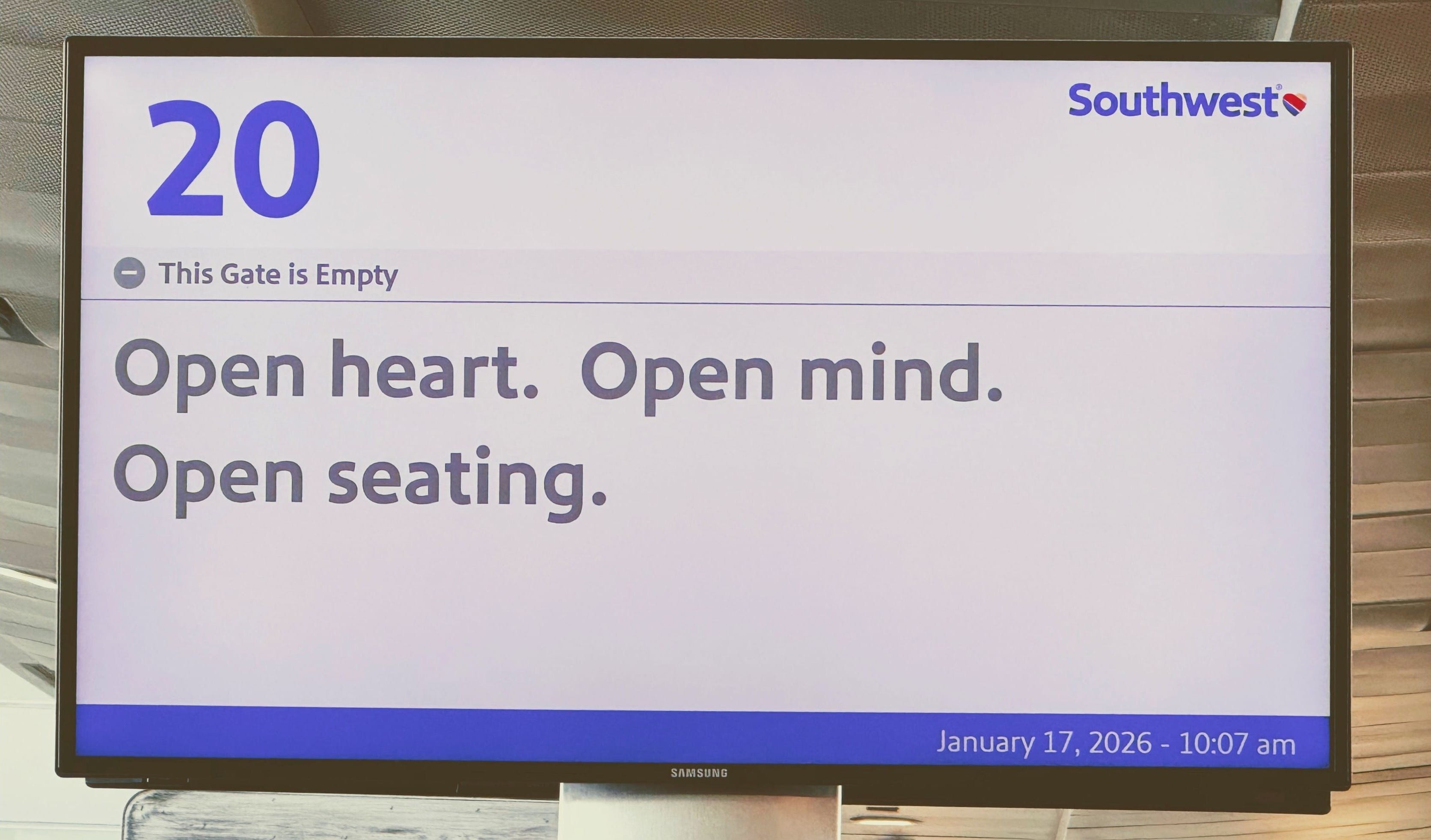
Southwest’s unique approach carried the company through 47 profitable years – the longest streak of any commercial airline – until the COVID-19 pandemic disruption of airline traffic. A holiday scheduling disaster in December 2022 decimated both profits and trust in the brand. Southwest leadership began exploring ways to reimagine their business model and brand hallmarks in order to bring in higher-margin offerings. Free checked bags were the first to go with open seating coming up next.
At some point, any differentiator stops being novel and leaders must decide if they continue to champion the differentiator, ensuring it remains core to the business model, or if they evolve and let the differentiator go. This surfaces an open strategic question: At what point does a strategic differentiator stop reinforcing a brand, and start eroding it?
Perhaps inevitably, in an industry hallmarked by homogeneity, Southwest now appears ready to conform.
The upcoming change is not necessarily a departure from the brand customer value proposition. Southwest’s vision is to be the “world’s most loved, most efficient, and most profitable airline.” They can be loved, efficient, and profitable even with customers sitting in assigned seats. This change is at the value chain level when considering the boarding process as one of the primary activities – and core differentiators – for the brand.
This raises another open strategic question: Once the differentiator is gone, does the brand slip into irrelevance? A move to align with the market could bring in new customers, but could also alienate existing customers.
The bet? Assigned seats, seats with extra legroom, and other offerings will increase the desirability of flying Southwest for both current and new customers. Over time, this will yield higher customer demand and increase profits for Southwest shareholders. Sustained, higher profits could be cascaded to keep prices comparatively low in the market for potential customers, further increasing demand.
The risk? Changing the quirkiest part of flying Southwest, particularly after ending the famous free checked bags policy in 2025, risks alienating the champions who fly Southwest on purpose, not just because of the convenience of flight paths. The friendly and casual open seating approach may be a significant contributor to the warm environment of a Southwest flight. If customers are booking Southwest today because it just feels different, this shift may disrupt their continued brand loyalty.
What do I think? On my first ever Southwest flight, I unexpectedly ran into my best friend from college, Ahmed, who I hadn’t seen in a while. Because of open seating, we sat together and spent the whole flight catching up. There is no other airline where this story could have happened. I haven’t seen Ahmed on a Southwest flight since…but I board every Southwest flight looking optimistically to unexpected possibilities.
Lavorgna Strategy Studio helps leaders, teams, and organizations prepare and plan for the future through strategic planning and strategic foresight. Connect with Jackie Lavorgna, Founder and Principal, to learn more about Lavorgna Strategy Studio and schedule a free discovery call today.
Really smart framing of differentiation as sometihng that can either anchor or erode brand value. Southwest's pivot kinda feels like they're betting assigned seats will bring in more revenue than they'll lose from the open-seating die-hards. Curious if they ran tests on what percentage of customers actually valued that feature vs just tolerated it for the price.